

Dr. Amy Strydom manages the 3D Cell Electron Microscopy (EM) Core at the Center for Quantitative Cell Imaging (CQCI). In this role, she oversees the daily operations of the core which houses a Talos F200C Transmission Electron Microscope and a Leica EM ICE high pressure freezer. The Core collaborates with scientists across campus, and beyond, on advanced imaging projects. In addition to its ability to generate conventional electron micrographs, the Core produces 3D tomographic reconstructions, allowing researchers to navigate cellular microstructures with the precision of a radiologist interpreting an MRI. In this Scientist Spotlight, Amy discusses her career path to UW-Madison, her current work, and what inspires her.
Tell us about your background and personal history.
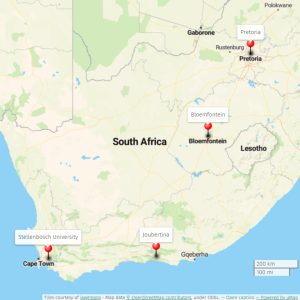 I was born and raised in a small town in the Eastern Cape of South Africa called Joubertina. My family lived in this region for a long time, and I was the third generation attending the school in town. I grew up in a big family and spent many happy holidays with cousins, aunts, and uncles. We loved camping in nature reserves and searching for animals.
After high school, I went to Stellenbosch University (near Cape Town) to pursue a degree in Food Science because people need to eat and I’d always have a job. I also signed up for a master’s degree to enhance my career prospects, but then fell in love with research inmy second week.
After 7 years in the Cape region, I followed my PI, Corli Witthuhn, to Bloemfontein to complete a PhD in Microbiology. Bloemfontein is a big city with a small-town vibe, so after my PhD I stuck around for 5 more years as a postdoc in a virology lab, working with Trudi O’Neill.
At this point I had dabbled in electron microscopy, so I applied for a Werner Baltes fellowship at the German Federal Institute for Risk Assessment (BfR) in Berlin, Germany to get officially trained. The pandemic derailed those plans, so I moved to Pretoria for another postdoc which focused on respiratory viruses, and I got to do some exciting work on SARS-CoV-2. Finally in 2022, I fulfilled the fellowship in Germany with Ashish Gadicherla.
After returning to South Africa, I worked in the animal feed industry, but I really missed doing research. When I learned of an opportunity at the 3D Cell EM Core with CQCI, I couldn’t let it pass by.
How did you get involved with electron microscopy? Was there a specific moment that made you decide that you want to specialize in EM?
I started off by imaging bacteriophages, and I immediately liked spending time at the microscope since it reminded me of looking for animals on a safari. For a quick experiment, mostly to satisfy my curiosity, I captured the life cycle of a bacteriophage in Listeria monocytogenes. Capturing that made me as happy as the first time I watched Jurassic Park as a kid (one of my favorite movies!). In the past year, I have had many similar moments working at UW-Madison..
What is your job like day to day?
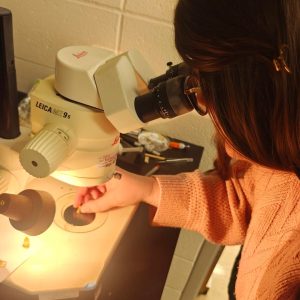 I take care of all aspects of the 3D Cell EM Core. Apart from checking the electron microscope for errors and liquid nitrogen levels, my days do not have a lot of routine. A couple of days a week I will do some alignments for the electron beam. I do project consultations for prospective scientists and sometimes Hong Zhan joins as a scientific advisor.
Depending on which projects are currently in progress, I might be freezing, processing, sectioning, or imaging samples. I also train and advise users who want to use the microscope independently. I also take care of the administrative side such as billing, ordering and reporting. I work closely with the administrative staff in Bock Labs, Marisa Otegui (3D Cell EM Core Director), and Kevin Eliceiri (CQCI Director) on the strategic management of the Core.
What do you like about working at the 3D EM Core?
The best part is the “Science is so cool!” moments. I really like getting exposure to a variety of research topics. At the moment, we are working on projects in plant sciences, microbiology, neurobiology, cardiology, orthopedics and rehabilitation. It is also really fun training new users and seeing how much they enjoy imaging.
What is the hardest part of your job?
I don’t enjoy the management part of the job as much as I enjoy the scientific aspects of my work. I’ve been thinking of taking some business courses to strengthen that part of my skillset.
What advice do you have for people who may follow in your footsteps?
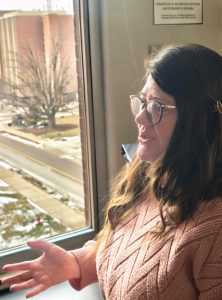 I would describe myself as someone who truly loves to learn, which is why I came back to research. My advice for young people who feel the same would be to explore different things and take risks. Apply for international scholarships and travel as much as you can.
Coming from that small town, I never imagined that I would work for one of the best universities in the world and do really cool things for a living. There aren’t too many formal programs to receive training in electron microscopy, so if you are interested, you should seek opportunities to work on a scope and get trained. We do a lot of this at the 3D Cell EM Core.
Where do you find inspiration or creative ideas?
There are so many! Here at UW, there are so many people doing interesting and really cool things. They inspire me to do the same. Other sources of inspiration are nature and the beautiful environments around Madison. The Springboks (South Africa’s national rugby team) have been great to watch and are a huge source of inspiration to never give up.
Electron Microscopy and Tomography
Electron microscopy is an imaging technique much more powerful than traditional light microscopes. Standard microscopes use visible light and glass lenses to magnify objects. They are limited by the physics of how light works and how well it can be focused, making it impossible to see tiny things like viruses or atoms. Electron microscopes use a beam of electrons to illuminate a sample. Unlike visible light, the electron beam can be focused with magnets to produce incredibly detailed images of very small structures.

An electron microscope with 3D capabilities goes a step further. To collect 3D images (electron tomography), samples are tilted under the electron beam and images are collected at every tilt. We have the capability to tilt the sample 120 degrees and take images at every degree. These images can then be reconstructed into a 3D rendering of the target area.
Why is it useful?
Electron tomography provides a remarkable perspective on structural information at the nanometer level. It allows you to see the internal organization and spatial relationships of complex structures. For example, electron tomography could let you see how viruses are assembled or how a cell organizes its internal scaffolding as it is being built. On a computer, you can rotate these 3D models to see interconnections or relationships that might otherwise be missed.

How can someone get access to using it?
We work with people from many different departments across campus and from outside organizations. You can email Amy (astrydom@wisc.edu) to discuss a project or training or use the online form on the 3D Cell Electron Microscopy Core Facility website.